
Equity Capital & Crowdfunding
Equity Capital and Crowdfunding empower Small Businesses by offering alternative funding sources.
One of the most prominent challenges for Small Business is raising adequate capital to launch new ventures. Entrepreneurs have traditionally relied upon funding from capital providers such as banks, venture capitalists, angel investors, or contributions from friends and family members. Crowdfunding allows entrepreneurs to directly appeal to the general public through online platforms for help in getting their innovative ideas off the ground.
Yet, equity crowdfunding platforms do not all follow the same model, charging different fees, offering different types of financial securities, and specializing in different sectors.
- Title III of the Jumpstart Our Business Startups (JOBS) Act passed in 2012 authorized equity crowdfunding— allowing small businesses to raise up to $1 million per year, through intermediaries facilitating crowdfunding transactions.
- According to the regulations, an individual investor may not contribute more than $100,000 in any 12-month period across all crowdfunding offerings. This cap is the same regardless of whether an investor is accredited or non-accredited. Additionally, the vast majority of Americans will face limits even lower than that, largely dependent on their income and assets.
- The JOBS Act sets high transaction costs required to raise $1 million. Issuers will find themselves with bills in the tens of thousands of dollars right out of the gate to pay for legal and accounting services—and will then have to spend at least a couple thousand dollars after fundraising to comply with ongoing reporting requirements.
- Transactions must be conducted through an intermediary that either is registered as a broker-dealer or a “funding portal.” A funding portal must register with the SEC and be subject to the SEC’s oversight. Furthermore, for companies that raise over $500,000, significant disclosures in the form of audited financials are required.
Equity capital and crowdfunding play a crucial role in providing Small Businesses with the financial support needed to innovate, grow, and compete in a dynamic market.
Working solutions
 Equity crowdfunding is a massively growing source of financing, especially since the pandemic: according to new research by Statista, global spending on equity crowdfunding will top $17.8 billion by the end of 2023 – up more than 15 percent from 2022 and a staggering 189% since 2020. With better underlying legislation and better implementing regulation, investment crowdfunding can provide a useful contribution to capital formation for the smallest companies. Properly done, crowdfunding can provide small, quick injections of funds into early stage or small companies.
- SEC should issue rules in-line with the intent of the law and avoid creating costly new regulatory regimes in the process.
- Lawmakers should clarify and ease costly and complex registration requirements on Small-Business owners seeking investment.
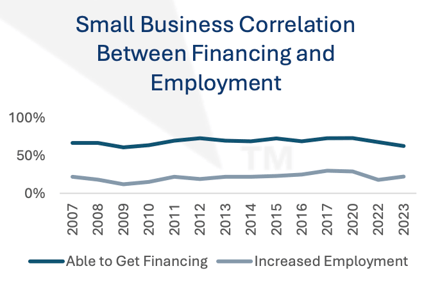
NSBA has been surveying our members on employment levels and financing for years, and there is a very clear correlation between hiring and availability of capital. When more Small Businesses have access to needed financing, they hire more people. When more Small Businesses have access to needed financing, they hire more people.
NSBA regularly conducts surveys among our members and small-business owners to produce insights that help inform our policy stances and influence important initiatives in Washington, D.C. and across the country.