
Pension Reform & Simplification
When a Small-Business owner is considering his or her retirement needs and those of his employees, there are myriad different plans to consider with countless requirements and stipulations.
Navigating an employee pension plan can be extremely complex and cumbersome and can lead to serious taxation issues for the Small-Business owner, which often places Small-Business employees at a disadvantage compared to other workers.
- Over the past 30 years, Congress has amended and revised the tax laws governing pension plans at an alarming rate, adding new layers of complexity with every change.
- The SECURE Act (Setting Every Community Up for Retirement Enhancement)—passed in 2019—made some key improvements to Small-Business pension offerings. The law provides tax credits for establishing new retirement plans, tax credits for establishing automatic enrollment plans, and the creation of Multiple Employers Plans (MEP) and Pooled Employer Plans (PEP).
- More recently, Congress passed SECURE 2.0, which made changes to make plans more attractive for most participants (such as loosening mandatory distribution requirements), but also created drawbacks, such as requiring that all catch-up contributions from highly compensated employees (and owners) be made to a Roth account.
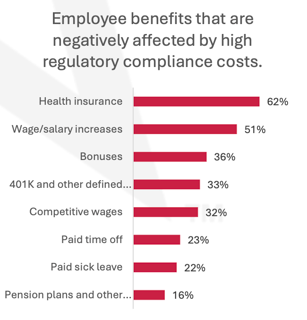
- Complex federal rules and legal costs prevent many Small Businesses from starting and maintaining employee pension plans. It is essential that the federal government re-examine its tax policy regarding pension plans.
Combine ease of administration with equitable contributions limits for all employers and workers.
Working solutions
 NSBA urges the administration, with the support of lawmakers, to:
- The current trade-off of lower contribution limits for ease of administration is unfair to Small-Business owners and their employees.
- In 2025, business owners and employees who participate in easier-to-administer SIMPLE 401(k) plans can save only $16,500 (before taxes) a year, compared to the $23,500 allowed under traditional 401(k) plans—a more costly and difficult option for small firms.
- While the SECURE Act made some much-needed adjustments to the country’s retirement system, it wasn’t a comprehensive solution to the retirement crisis in America. More improvements should be enacted to further provide Small Businesses with more flexibility with respect to the tools and resources available to provide retirement options for them and their employees.