
Repeal the Corporate Transparency Act
More can and should be done to ensure fairness for Small Business and firms in the federal marketplace.
The Corporate Transparency Act (CTA) requires ONLY certain businesses with fewer than 20 employees to disclose beneficial owners’ information to the Department of the Treasury’s Financial Crimes Enforcement Network (FinCEN), establishing a database of those names and duplicating information already being collected by the IRS.
The CTA requires Small Businesses to submit annual paperwork, including personally identifiable information of each Small-Business owner, upon the creation of the business and periodically throughout its life. Intentional or otherwise, failure to comply would constitute a federal crime and could result in civil penalties up to $10,000, as well as criminal penalties of up to two years in prison. The law also grants broad access to the information to federal, state, local, or tribal law enforcement agencies without having to obtain a subpoena. By the numbers:
- Large companies are mostly exempt from the CTA—only those with 20 or fewer employees and $5 million or less in annual sales need to report ownership information to FinCEN.
- Millions of Small-Business owners will be faced with an additional $5.7 billion in regulatory paperwork – imposing burdensome, duplicative reporting on the Smallest Businesses in the U.S. and threatening the privacy of law-abiding, legitimate Small-Business owners.
- More than 4.9 million Small-Businesses will be required to provide personal ownership information to FinCEN on an annual basis. The Treasury Department would be required to retain the information for the life of the business plus five years.
While NSBA supports the goal of stemming money laundering, the CTA is not the proper way to achieve this goal.
Working solutions
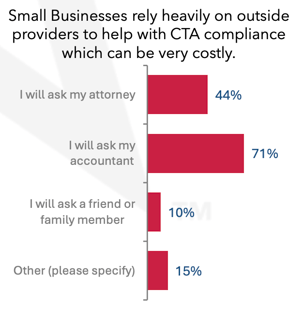
NSBA has prevailed in its Federal District Court suit against Treasury seeking to overturn the CTA’s mandate. Still, a myriad of conflicting federal-court decisions has followed, leaving behind a muddled compliance landscape for Small-Business owners. As such:
- Treasury should use existing forms and databases for collecting ownership information. • Lawmakers should seek every avenue possible to repeal the CTA and stop proposed regulations from going into effect.
- Any proposal to stem money-laundering MUST require information sharing between FinCEN and the IRS and carve out an exemption for Small Businesses.
- Small Business should NOT be penalized due to big banks’ unwillingness to collect and report on information they’ve historically collected.