
Strengthen Ex-Im Bank
The Export-Import Bank provides certainty for Small-Business exporters supporting economies worldwide.
The Export-Import Bank of the United States (EXIM) operates under a renewable general statutory charter, most recently extended through Dec. 31, 2026, as part of a consolidated appropriations bill from the 117th Session of Congress.
Enacted on Dec. 20, 2019, the reauthorization permits the Bank to approve new transactions as the official U.S. export credit agency (ECA), providing financing and insurance to facilitate U.S. goods and services exports when the private sector is unable or unwilling to do so.
- For FY2021, EXIM reported authorizing $5.1 billion for more than 2,000 transactions, supporting approximately $9.2 billion of U.S. export sales – the lowest authorization rates have been since 2018, and down further from $20 billion authorized in 2014.
- With a Congressional mandate to make least 30 percent of its total financing authority available to support Small Business exports, Small Businesses comprised 28.2 percent of FY2021’s authorizations.
- Currently, the Board operates with only four of five voting members confirmed. Since no more than three of the five voting members may be of the same political party, during his term, President Biden declined to name a Republican member to the Board. This should not be a political issue: small exporters deserve a full Board.
- With EXIM still reconciling the effects of vacancies and lapsed reauthorizations, even for Small Business, China, Germany, and the UK continue to dominate global export credit financing, underscoring the competitive disadvantage the United States faces when one of its Small-Business credit arteries is clogged by partisanship and bureaucratic inefficiencies.
Congress should ensure EXIM is able to operate at maximum efficiency to support Small Business’ impacts worldwide.
Working solutions
EXIM plays a critical role in filling gaps in private-sector financing for Small-Business exports, helping U.S. firms compete against foreign ECA-backed firms.
Working with the Small Business Exporters Association (SBEA) – NSBA’s export and trade policy arm – EXIM should continue to strive to exceed its mandates of supporting Smal-Business exporting efforts, reestablishing its reliability as a resource to address inabilities to access traditional credit or financing.
Sluggish progress on addressing backlogged, pending project finance requests is costing American jobs and competitiveness overseas, leading to trade imbalances and slower growth opportunities, especially for small exporters.
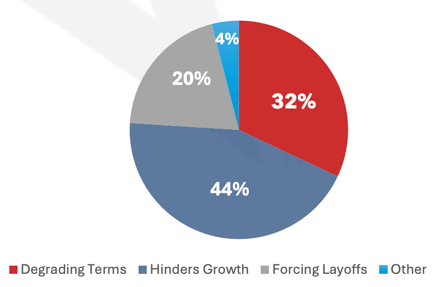
According to respondents of NSBA’s most recent Exporter Survey, 32 percent of Small-Business owners say terms of loans have become less favorable; 44 percent said lack of capital hinders growth of their business; and another 20 percent said limited credit has forced layoffs of Small-Business employees and workers.
NSBA regularly conducts surveys among our members and SmallBusiness owners to produce insights that drive our Priority Issues and influence important initiatives in Washington and across the country.